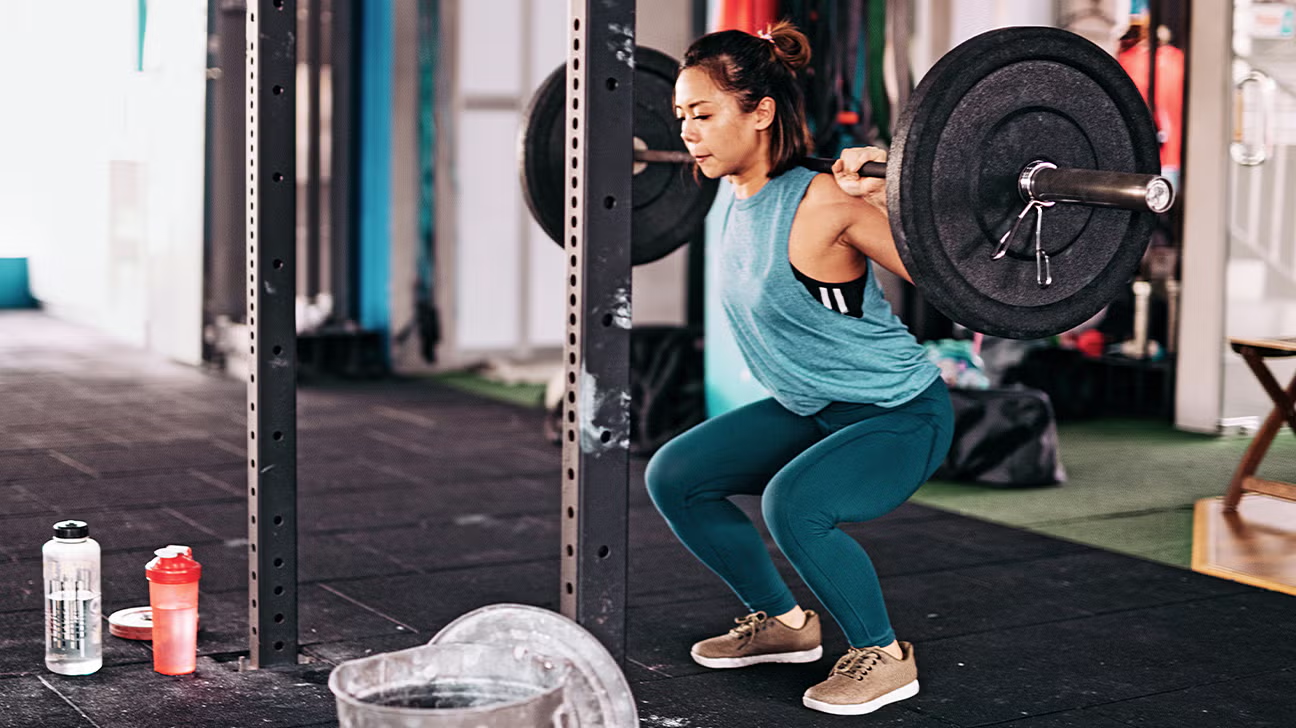

If you have been working out consistently but your strength and muscle growth have stopped improving, the problem may not be your exercise selection. You may simply be doing the same amount of work without giving your body a reason to adapt.
That is where progressive overload for beginners becomes important.
Progressive overload means gradually making your training more challenging over time. You might lift a little more weight, complete more repetitions, improve your technique, or increase the difficulty of an exercise. The goal is not to make every workout brutally hard. It is to give your body a manageable challenge that encourages adaptation.
Used correctly, progressive overload can help beginners build strength, gain muscle, and make steady progress without constantly changing their workout routine.
What Is Progressive Overload?
Progressive overload is the gradual increase of training demands placed on your muscles and body over time.
When you first start exercising, almost any consistent resistance training can produce results. Your body is responding to a new stimulus. After a while, however, the same workout becomes easier.
For example, if you perform 3 sets of 10 push-ups every Monday for six months, your body may eventually adapt. You may maintain your current fitness level, but you are no longer providing much new stimulus for further improvement.
To keep progressing, you need to gradually increase the challenge.
That could mean:
- Adding weight to an exercise
- Performing more repetitions
- Completing an additional set
- Improving your range of motion
- Using better technique
- Reducing rest time in certain situations
- Choosing a more difficult exercise variation
The key word is gradually. Progressive overload is not about pushing your body to its absolute limit every session.
Why Progressive Overload Matters for Muscle Growth

Your body adapts to the demands you place on it.
When resistance training creates enough stress, your muscles repair and adapt during recovery. Over time, this can lead to increased strength and muscle size.
However, your body has no reason to keep building more strength if the demands never increase.
Think of it this way: your first month of training might make a 10 kg dumbbell feel challenging. After several months, that same dumbbell may feel much easier. If you want to continue improving, you may eventually need to use a heavier dumbbell, perform more repetitions, or make the exercise more difficult.
This is why progressive overload is one of the foundations of effective strength training.
How to Use Progressive Overload as a Beginner
You do not need to use every progression method at once. In fact, trying to increase everything simultaneously is a common mistake.
Choose one variable and progress it gradually.
1. Increase the Weight
This is the method most people think of first.
If you can perform all your planned repetitions with good form and still have a little energy left, you may be ready to increase the resistance.
For example:
- Week 1: Squat 40 kg for 8 repetitions
- Week 2: Squat 40 kg for 10 repetitions
- Week 3: Squat 42.5 kg for 8 repetitions
The increase does not need to be dramatic. Even a small improvement can add up over time.
Also Read How Much Protein Do You Really Need? A Beginner’s Guide to Daily Protein Intake
2. Add More Repetitions
Increasing repetitions is useful when you are working within a specific rep range.
Suppose your program calls for 8 to 12 repetitions. You might start with:
- Set 1: 8 reps
- Set 2: 8 reps
- Set 3: 9 reps
Over time, you may reach:
- Set 1: 12 reps
- Set 2: 12 reps
- Set 3: 12 reps
At that point, you can increase the weight slightly and work your way back toward the lower end of the range.
This method is often called double progression, and it is simple and effective for beginners.
3. Add a Set
Adding another set increases the total amount of work your muscles perform.
For example:
- Weeks 1 to 3: 3 sets of rows
- Weeks 4 to 6: 4 sets of rows
More sets can be useful, but more is not always better. If your recovery, sleep, or technique starts suffering, increasing volume may be doing more harm than good.
4. Improve Your Technique
Progress does not always mean lifting heavier.
Better form can make an exercise more challenging and more effective. A deeper squat, controlled lowering phase, or improved range of motion may increase the demand on the target muscles.
A common mistake beginners make is adding weight before they have learned to control the movement.
If your technique breaks down significantly, the weight is probably too heavy for your current ability.
What Is the Best Way to Track Progressive Overload?
You do not need an expensive fitness app.
A notebook, spreadsheet, or simple phone note can work perfectly well.
Record:
- Exercise
- Weight used
- Number of sets
- Repetitions completed
- Important notes about technique or difficulty
For example:
Dumbbell Bench Press
Week 1: 15 kg, 3 sets of 8
Week 2: 15 kg, 3 sets of 10
Week 3: 17.5 kg, 3 sets of 8
This makes your progress visible and helps you avoid guessing.
If you have been training for a few weeks and still feel stuck, this could be why. Many people remember their workouts vaguely but do not track what they are actually doing. Without tracking, it is difficult to know whether you are progressing.
A Simple Progressive Overload Example
Here is a basic example using the goblet squat:
Week 1: 15 kg, 3 sets of 8
Week 2: 15 kg, 3 sets of 10
Week 3: 15 kg, 3 sets of 12
Week 4: 17.5 kg, 3 sets of 8
The process then repeats.
This approach works because you increase the challenge gradually while keeping the exercise familiar. You do not need to change exercises every week to make progress.
Common Progressive Overload Mistakes
Increasing Weight Too Quickly
Adding more weight every workout may sound like fast progress, but your muscles, joints, tendons, and technique all need time to adapt.
If your form becomes poor, slow down.
Training to Failure on Every Set
Training to failure means continuing until you cannot complete another repetition with proper form.
It can have a place in a training program, but beginners do not need to reach failure constantly.
Leaving a few good repetitions in reserve can help you maintain better technique and recover more effectively.
Ignoring Exercise Form
Lifting heavier while using poor technique is not genuine progress.
If you need to swing, bounce, or use excessive momentum to complete a repetition, the weight may be too heavy.
Pain is also a warning sign. Normal muscle fatigue and effort are different from sharp, sudden, or worsening pain. Stop an exercise and seek guidance from a qualified professional if you experience concerning symptoms.
Changing Your Workout Too Often
A new exercise may feel exciting, but changing your routine every week makes it difficult to measure progress.
Beginners often benefit from keeping key exercises in their program long enough to improve technique and performance.
Forgetting Recovery
Training is only one part of the process.
Sleep, nutrition, rest days, stress, and your overall training history all affect how quickly you can progress. Someone sleeping eight hours and eating enough may progress differently from someone training hard while constantly tired and under-eating.
Who Is Progressive Overload Best For?
Progressive overload is useful for almost anyone doing resistance training, including:
- Complete beginners
- People training at home
- Gym beginners
- Individuals trying to build muscle
- People working to improve strength
- Busy professionals using short workouts
- Older adults following an appropriate strength program
The method can be adapted to bodyweight training as well. For example, you might progress from wall push-ups to incline push-ups, then standard push-ups, and eventually more difficult variations.
People with injuries, significant pain, or certain medical conditions may need a modified training plan. If you are unsure whether a particular exercise is appropriate, consult a doctor, physiotherapist, or qualified fitness professional.
How Fast Should You Progress?
There is no single timeline that works for everyone.
Beginners often improve quickly at first because they are learning both the exercises and the skill of producing force. Progress may slow later.
Your results can vary based on:
- Age
- Genetics
- Sleep
- Nutrition
- Training experience
- Stress
- Exercise selection
- Consistency
Some weeks you may add weight. Other weeks, simply matching your previous performance with better form may be a successful workout.
Progress is not always linear, and trying to force it can lead to unnecessary fatigue or injury.
Frequently Asked Questions
How often should I use progressive overload?
You should aim to gradually progress whenever you are ready, but not necessarily every workout. Some exercises may improve weekly, while others may take several weeks.
Is progressive overload necessary to build muscle?
Some form of progressive challenge is generally important for continued muscle growth. However, progression can involve more than simply lifting heavier weights.
Can I use progressive overload with home workouts?
Yes. You can increase repetitions, use resistance bands or weights, improve range of motion, slow down the movement, or progress to a more difficult exercise variation.
Should I increase weight if my form is poor?
No. Improve your technique first. Adding weight to an exercise you cannot control properly can increase unnecessary stress on your joints and reduce the quality of the movement.
What if I cannot progress every week?
That is normal. Strength and muscle growth do not happen on a perfectly predictable schedule. Focus on long-term improvement rather than forcing progress during every session.
Final Thoughts
Progressive overload for beginners is much simpler than it may first appear. You do not need to constantly lift heavier weights or train until exhaustion.
Start with good technique, track your workouts, and gradually increase the challenge when your current workload becomes manageable. Sometimes that means more weight. Sometimes it means more repetitions, better control, or a more difficult exercise variation.
The best training plan is one you can perform consistently and recover from. Over time, small improvements in progressive overload can lead to meaningful gains in strength, muscle, and overall fitness.
