
You don’t need a gym membership or expensive equipment to lose body fat. A well-planned home workout can improve your fitness, strengthen your muscles, and help you burn calories when paired with healthy eating habits. The challenge isn’t finding exercises. It’s knowing which ones are actually worth your time.
The best fat-burning exercises you can do at home are movements that engage multiple muscle groups, raise your heart rate, and are easy enough to perform consistently. Combined with a balanced diet and regular activity, they can support sustainable fat loss without making fitness feel overwhelming.
Quick Answer
The best fat-burning exercises you can do at home include bodyweight squats, push-ups, mountain climbers, jumping jacks, burpees, lunges, high knees, planks, step-ups, and brisk walking. These exercises work best when combined into a consistent workout routine and paired with a calorie-controlled, nutritious diet.
Why Home Workouts Can Be Effective for Fat Loss
Many people believe they need complicated gym machines to burn fat.
That’s simply not true.
Fat loss happens when your body consistently uses more energy than it receives from food over time. Exercise increases your daily energy expenditure, helps preserve muscle, improves cardiovascular fitness, and supports overall health.
Home workouts also remove common barriers like commuting to the gym, waiting for equipment, or finding extra time during a busy day.
One thing most people underestimate is that a workout you’ll actually complete is always more effective than the “perfect” routine you never start.
How Fat-Burning Exercises Work
Despite the name, no exercise burns fat from one specific area of your body.
Instead, these exercises increase your energy expenditure and help create the calorie deficit needed for overall fat loss.
Exercises that involve several large muscle groups generally require more energy than isolated movements. They also improve strength, coordination, and endurance.
For the best results, combine:
- Strength-focused bodyweight exercises
- Moderate or higher-intensity cardio
- Daily movement like walking
- Balanced nutrition
- Adequate sleep and recovery
The Best Fat-Burning Exercises You Can Do at Home
1. Bodyweight Squats
Squats strengthen your legs, glutes, and core while increasing your heart rate.
Keep your chest up, push your hips back, and lower until your thighs are roughly parallel to the floor or as far as your mobility allows.
Begin with 10 to 15 repetitions.
2. Push-Ups
Push-ups build upper-body strength while engaging your core.
If standard push-ups feel too difficult, start with incline push-ups against a wall or sturdy countertop.
Good technique is more important than high repetition numbers.
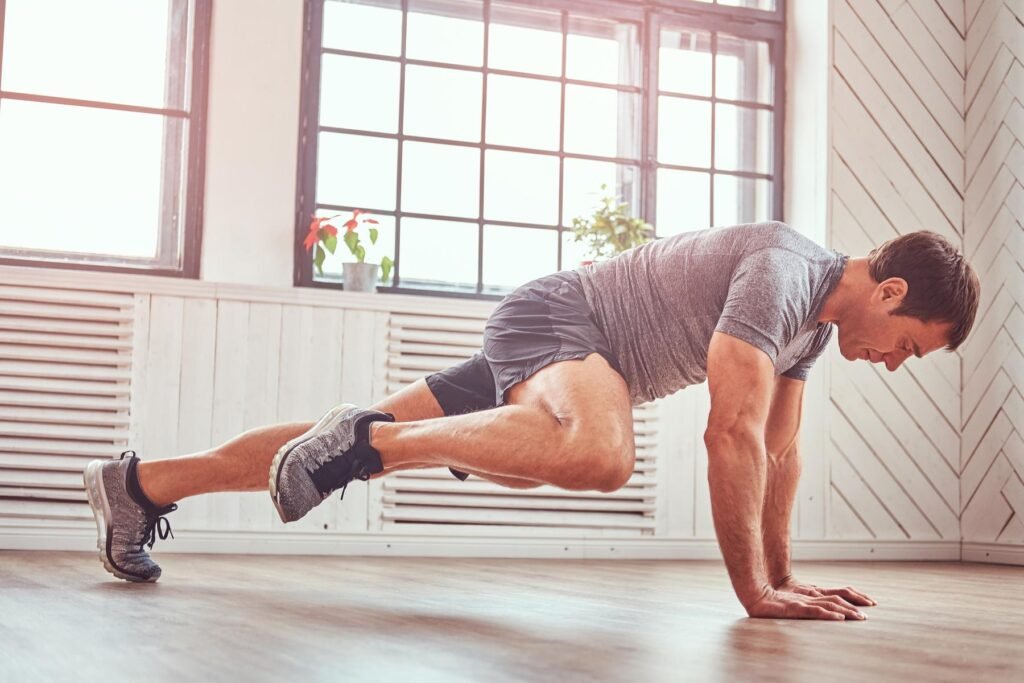
3. Mountain Climbers
Mountain climbers combine core training with cardiovascular exercise.
Maintain a straight body position and move your knees forward at a controlled pace before gradually increasing speed.
Aim for 20 to 40 seconds.
4. Walking Lunges or Reverse Lunges
Lunges strengthen your legs while improving balance and coordination.
Reverse lunges are often easier on the knees for beginners.
Take controlled steps and avoid letting your front knee collapse inward.
5. Jumping Jacks
A classic exercise that raises your heart rate quickly without requiring equipment.
If jumping bothers your joints, step one foot out at a time instead of jumping.
6. High Knees
High knees improve cardiovascular fitness while engaging your lower body and core.
Start slowly before increasing your pace.
Keep your posture upright instead of leaning backward.
7. Burpees
Burpees challenge nearly every major muscle group while elevating your heart rate.
They’re demanding, so beginners can remove the push-up or jump until they build confidence.
Quality movement is far more valuable than rushing through repetitions.
Also Read 10 Common Beginner Workout Mistakes and How to Avoid Them
8. Planks
Although planks aren’t high-calorie burners by themselves, they strengthen your core and improve stability for many other exercises.
Keep your body in a straight line without allowing your hips to sag.
9. Step-Ups
Using a sturdy step or low platform, step up with one leg before returning under control.
This exercise builds lower-body strength while adding a cardiovascular challenge.
Ensure the surface is stable before beginning.
10. Brisk Walking
Walking is often overlooked because it feels too simple.
In reality, it’s one of the most sustainable forms of exercise for beginners.
Walking daily supports fat loss, improves heart health, reduces stress, and is easier to recover from than high-intensity training.
A Simple 25-Minute Beginner Home Workout
Try this routine two to four times each week.
Complete each exercise for 40 seconds, then rest for 20 seconds before moving to the next.
- Bodyweight squats
- Push-ups or incline push-ups
- Mountain climbers
- Reverse lunges
- Jumping jacks
- Plank
Rest for one to two minutes after completing all exercises, then repeat the circuit three times.
Adjust the work and rest periods if needed based on your current fitness level.
Common Mistakes to Avoid
Doing Only Cardio
Cardio burns calories, but strength exercises help preserve muscle while losing fat.
A combination of both usually produces better long-term results.
Ignoring Exercise Technique
Poor form increases injury risk and makes exercises less effective.
Slow down and master each movement before trying harder variations.
Skipping Recovery
Recovery allows your muscles to adapt to training.
Aim for 7 to 9 hours of sleep and include at least one or two rest days each week.
Expecting Exercise Alone to Burn Fat
Exercise supports fat loss, but nutrition plays a major role.
Even the best workout routine cannot consistently overcome a diet that provides more calories than your body needs.
Training Too Hard Every Day
A common mistake beginners make is believing soreness equals progress.
Feeling challenged is normal. Constant exhaustion is not.
If you’ve been working out consistently but always feel fatigued, reducing workout intensity or improving recovery may help.
Simple Starting Checklist
Before beginning your home workout routine:
- Warm up for 5 to 10 minutes.
- Wear supportive footwear if needed.
- Keep water nearby.
- Focus on proper technique.
- Increase repetitions gradually.
- Finish with light stretching.
These small habits improve both safety and consistency.
Who These Exercises Are Best For
These exercises work well for:
- Beginners starting a weight-loss journey
- People who prefer home workouts
- Busy professionals
- Students
- Anyone without access to a gym
If you have severe joint pain, balance issues, heart disease, recent surgery, or another medical condition, speak with your doctor or physiotherapist before beginning a new exercise program.
Stop exercising if you experience chest pain, severe dizziness, or sharp pain during movement.
Realistic Expectations
Home workouts can absolutely support fat loss, but they require consistency.
Most people notice improvements in energy and endurance within a few weeks.
Visible fat loss usually depends on maintaining a calorie deficit over several weeks or months, along with regular exercise, quality sleep, and balanced nutrition.
Results vary based on age, starting body composition, genetics, activity level, and overall lifestyle.
Focus on building habits rather than chasing rapid changes.
Frequently Asked Questions
Can I lose weight with home workouts alone?
Yes, provided your overall calorie intake supports fat loss. Nutrition and exercise work best together.
Which home exercise burns the most calories?
Exercises like burpees, mountain climbers, jumping jacks, and high knees generally increase heart rate quickly, but total calorie burn depends on workout intensity, duration, and your body size.
How often should beginners work out at home?
Three to four sessions each week is a realistic starting point for most beginners.
Do I need equipment?
No. Most beginners can build strength and improve fitness using bodyweight exercises alone.
How long should a home workout last?
A focused workout lasting 20 to 40 minutes is enough for many people, especially when performed consistently.
Final Thoughts
The best fat-burning exercises you can do at home are the ones you can perform safely, consistently, and with good technique. You don’t need fancy equipment or long workout sessions to make progress.
Choose a handful of effective bodyweight exercises, combine them into a routine you enjoy, eat a balanced diet, and stay active throughout the day. Those simple habits, repeated consistently, will have a much bigger impact than any short-term fitness trend or extreme workout challenge.
